
Все, что вам нужно знать о сетчатых тканях
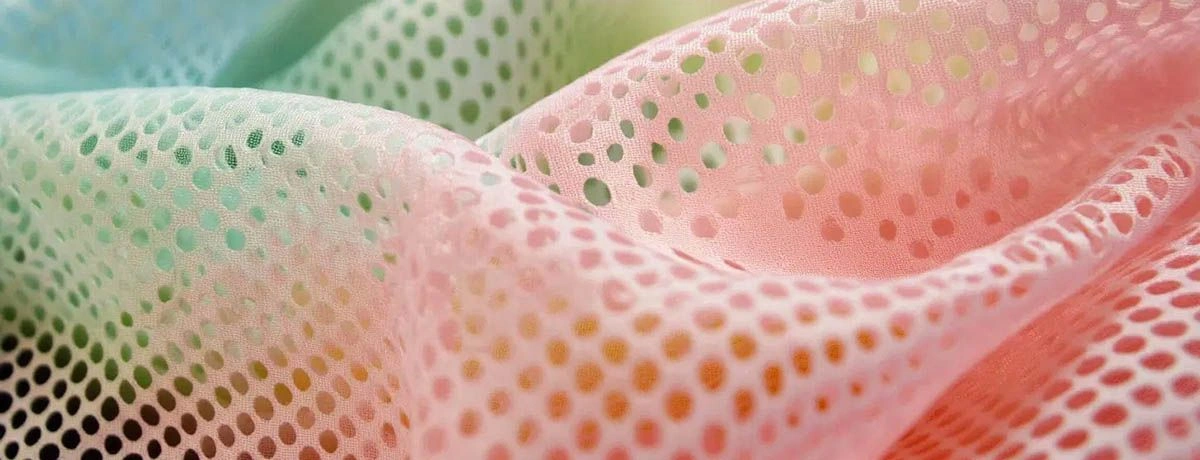
Mesh fabric is a textile built with regular open holes, so air and light pass straight through it. Most сетчатые ткани are warp-knitted from polyester or nylon, sometimes with spandex for stretch; others are woven, coated with PVC or TPU, or knitted as a thick 3D spacer.
"Mesh" therefore covers everything from 20 GSM bridal tulle to 400 GSM 3D air mesh for chair backs.
Основные выводы
- Mesh is a structure, not a fiber. The open holes give breathability; the fiber and construction set strength, stretch and hand.
- Polyester mesh is the default for sportswear linings and bags: it absorbs very little water (moisture regain about 0.4%) and holds colour well.
- Nylon mesh is softer and stronger at the same weight, which is why it's used for lingerie, tulle and power mesh.
- Warp knitting (tricot and raschel) makes most mesh; woven and coated mesh are stiffer and used for industrial, outdoor and furniture work.
- Typical weights run from about 20-40 GSM (tulle) to 300 GSM and above (3D spacer and vinyl mesh).
Что такое сетчатая ткань?
Mesh fabric is any knitted or woven cloth whose yarns are arranged to leave evenly spaced tiny holes, giving a net-like look. Those openings make it lightweight because the open structure uses less material than a solid textile of the same size, while also letting air move through freely and sweat evaporate faster.
Most mesh fabrics are made from polyester or nylon, with breathability, stretch, and durability varying by fiber and construction, which is why mesh shows up wherever ventilation matters more than full coverage.
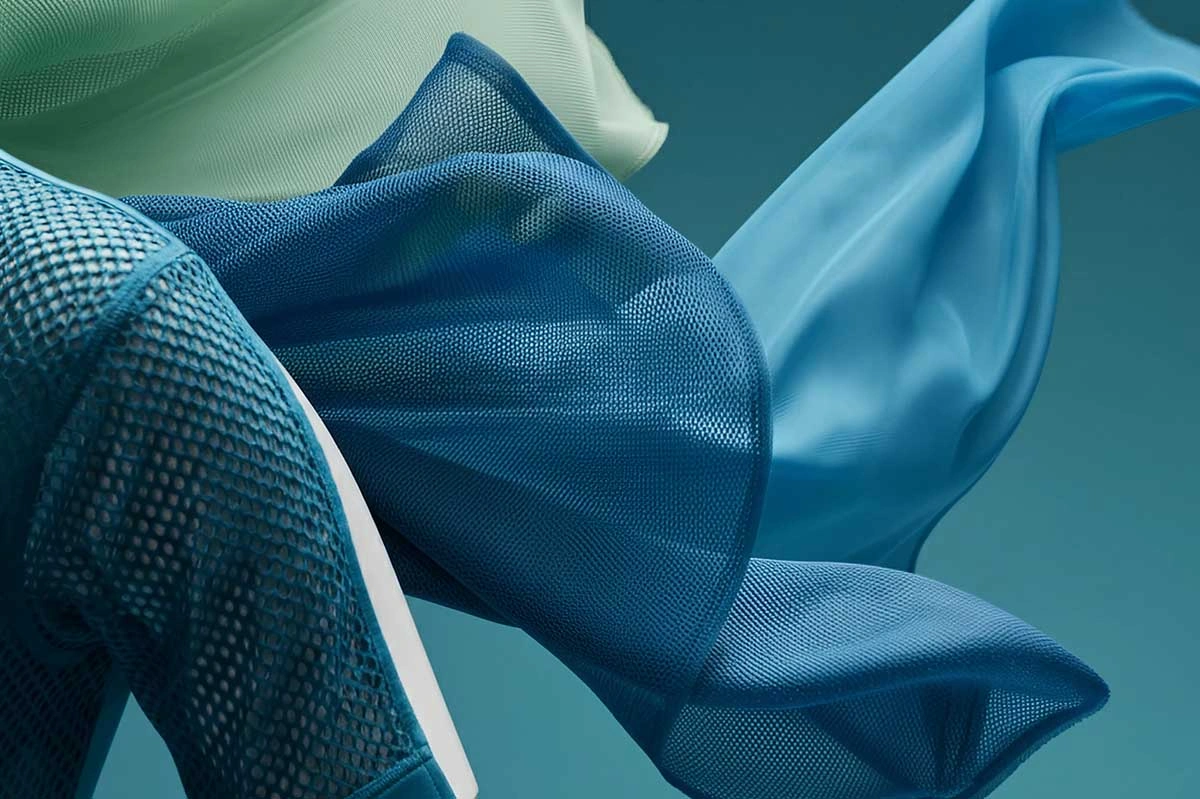
For apparel manufacturers, fabric buyers, textile industry professionals, and anyone comparing options for sportswear, fashion, medical, industrial, or outdoor products, the structure of those tiny holes is what makes mesh worth understanding before you source it.
Their shape varies: hexagonal (as in tulle and honeycomb mesh), diamond, square, round "bird's eye" eyelets, or the large open grid of a net. Hole size runs from pin-prick eyelets under 1 mm in sports jersey to several millimetres in ткань с крупной сеткой for laundry bags and netting.
What Is Mesh Fabric Made Of?
Most mesh fabric is made of polyester or nylon filament yarn, often blended with spandex for stretch. For synthetic mesh, the process begins with refining petroleum oil into polyamide monomers for nylon and comparable feedstocks for polyester. Those polymers are then melted and pushed through spinnerets to form polymer strands before they are turned into yarn.
Polyester is the volume choice because it's strong, dries fast and resists UV and stains; nylon is chosen when a softer hand, higher strength-to-weight or better stretch recovery is needed. Cotton and rayon blends appear only in a small share of soft, casual mesh.
| База со стекловолокном | Типичный состав | What it brings to mesh | Общие продукты |
|---|---|---|---|
| Доступны в четырех великолепных цветах, чтобы дать людям больше возможностей соответствовать их спортивной одежде. | 100% полиэстер | Low water absorption (~0.4% regain), colourfast, UV-resistant, economical | Sports linings, bag mesh, jerseys, 3D spacer |
| Переработанный полиэстер (rPET) | 50-100% переработанного ПЭТ | Performs like virgin polyester; supports recycled-content claims | Eco activewear, footwear uppers |
| Нейлон (полиамид) | 100% нейлон | Softer, stronger and more abrasion-resistant at the same weight | Tulle, lingerie, transparent nylon mesh |
| Нейлон / спандекс | about 75-85% nylon, 15-25% spandex | High stretch and firm recovery | Power mesh, shapewear, bra wings |
| Полиэстер / спандекс | примерно 85-92% полиэстера, 8-15% спандекса | Stretch at a lower cost than nylon | Swimwear, activewear panels |
| Cotton or rayon blends | Cotton-rich or rayon blends | Matte, soft, more absorbent | Casual tops, мягкая сетка |
Typical compositions only. Exact ratios vary by mill and quality.
Polyester and nylon behave differently with water, which matters for close-to-skin mesh. Polyester's moisture regain is about 0.4%, while nylon's is about 4%, so polyester mesh dries faster and nylon mesh feels a little warmer and softer. Both polyester or nylon fibers rely on petroleum, an unsustainable resource, and producing them uses significant water; for nylon fibers, the adipic acid used in manufacture also releases nitrous oxide, a greenhouse gas about 300 times worse than CO2.
Spandex content is what turns either fiber into эластичная сетчатая ткань, and the same separate strands appear in plain-face полиэфирная ткань и Эластичная ткань в 4 направлениях. Neither polyester nor nylon biodegrade, so mesh garments made from them can persist for centuries after they are sold.
How Is Mesh Fabric Made?
Mesh fabric can be made in different ways: warp knitting, weft knitting or weaving, with coating or lamination added afterwards for some industrial grades. Warp knitting dominates, because tricot and raschel machines can lock each loop in place and form stable, run-resistant holes at high speed.
| Строительство | How the holes form | Stretch and stability | Типичная сетка |
|---|---|---|---|
| Warp knit (tricot) | Yarns zig-zag lengthwise and skip needles to leave holes | Stable, little stretch unless spandex is added | Tricot mesh, linings, bird's eye jersey |
| Warp knit (raschel) | More guide bars build open, patterned structures | Very open, can be stiff or stretchy | Tulle, power mesh, warp-knit American mesh, сеть |
| Double-needle-bar raschel | Two faces knitted together with spacer yarns between them | Thick, cushioned, holds shape | 3D spacer / air mesh |
| Weft knit (circular) | Tuck stitches leave small eyelets in a single-jersey knit | Soft with natural mechanical stretch | Eyelet sports mesh, casual tops |
| Woven (leno or plain) | Warp yarns twist around weft yarns to lock open spaces | Rigid, low stretch, dimensionally stable | Screen mesh, produce bags, base cloth for coating |
| Coated / laminated | Woven or knitted mesh coated with PVC or TPU | Stiff, weather- and abrasion-resistant | Vinyl mesh, TPU-coated polyester mesh |
General characteristics. Performance depends on yarn denier, gauge, density and finish.
Knitted mesh, including the knitted mesh fabric used in sportswear, stretches more than woven mesh, while woven and coated mesh hold their shape under load, and some polyester and nylon versions are engineered for stricter dimensional stability or performance requirements.
What Are the Main Types of Mesh Fabric, Including Polyester Mesh?
There are a few different types of mesh fabric—indeed many types and other types exist—but the main categories are tricot (sports) mesh, power mesh, Powernet, tulle and net, 3D spacer mesh, and coated vinyl mesh.
Silk can also be used for some tulle, unlike the more common synthetic versions. Weight is one of the quickest ways to tell them apart: tulle can sit near 20 GSM, while spacer and vinyl mesh often exceed 300 GSM.
| Тип | Типичное волокно | Типичный вес | Характер | Типичное использование |
|---|---|---|---|---|
| Tricot / sports mesh | Доступны в четырех великолепных цветах, чтобы дать людям больше возможностей соответствовать их спортивной одежде. | примерно 80-160 г/м² | Light, stable, fine or bird's eye holes | Jersey linings, team wear, sports jerseys, shirts, and other clothing such as bag pockets |
| Силовая сетка | Нейлон / спандекс | примерно 120-220 г/м² | Sheer, high stretch with clear compression abilities | Shapewear, bra wings, activewear panels; Powernet has a relatively dense weave suited to shaping apparel such as bras, tights, and top tights |
| Tulle and net | Нейлон или полиэстер | примерно 15-40 г/м² | Very light, hexagonal holes, crisp or soft | Bridal veils, skirts, costumes |
| 3D spacer / air mesh | Доступны в четырех великолепных цветах, чтобы дать людям больше возможностей соответствовать их спортивной одежде. | about 200-450 GSM, 2-10 mm thick | Cushioned, breathable, shape-holding | Backpack straps, shoe uppers, office chairs, mattresses |
| Vinyl (PVC-coated) mesh | Polyester base + PVC | примерно 300-600 г/м² | Stiff, weatherproof, UV-resistant | Outdoor furniture, banners, gear bags |
| Large-hole net | Полиэстер или нейлон | меняется | Very open grid, strong | Laundry bags, sports nets, cargo nets |
Typical ranges. Weights overlap between types, so construction and GSM together describe a quality better than the type name alone.
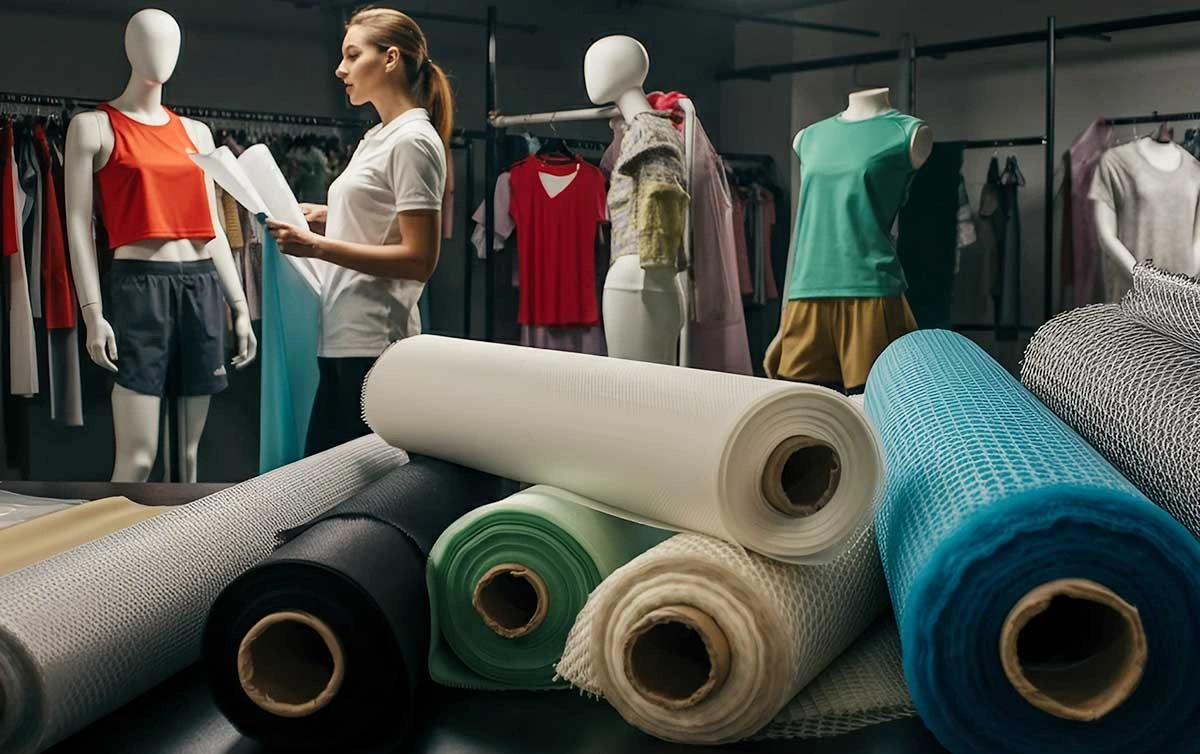
What About Breathable, Waterproof and Soft Mesh?
These names describe a property, not a separate construction. Дышащая сетчатая ткань is usually an open tricot or spacer mesh chosen for airflow. Waterproof mesh fabric is a coated or laminated mesh, since open holes alone can't stop water. Soft mesh fabric is typically a fine-denier nylon or microfiber polyester mesh with a brushed or soft finish, used in lingerie and linings. For the stretch-specific variants, see our guide to сетчатая ткань стрейч.
Where Is Mesh Fabric Used in Athletic Apparel?
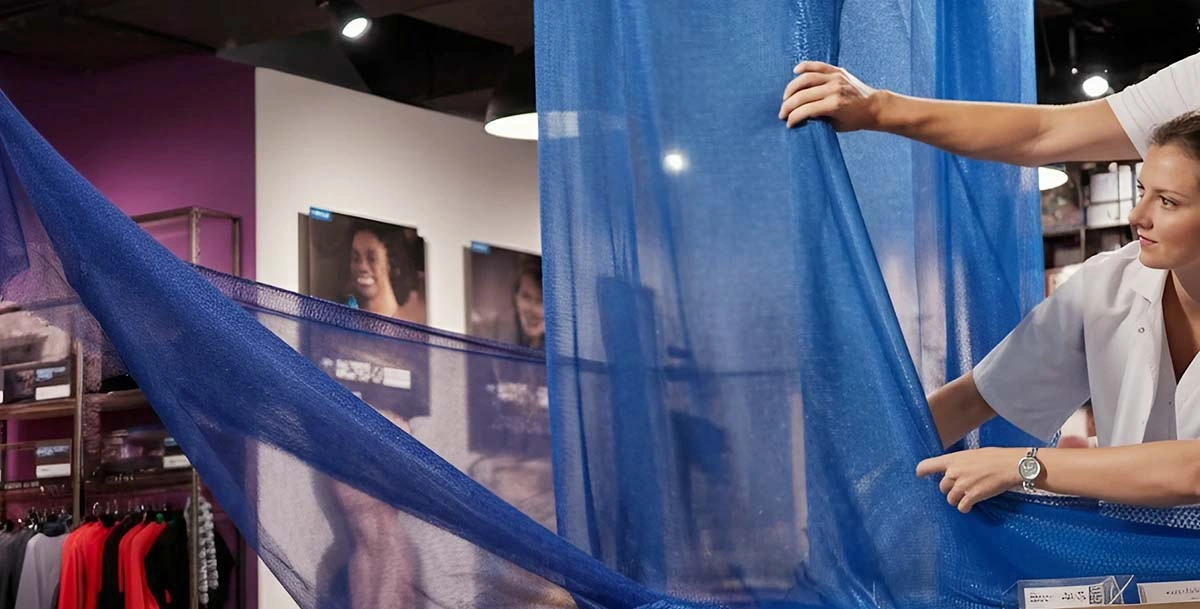
Mesh fabric is used mainly in sportswear and activewear, intimate apparel, bags and footwear, furniture and outdoor products, and medical and industrial textiles. Its unique properties suit different applications across many products because the product needs airflow, lightness or see-through structure in a specific zone, and mesh supplies it without adding weight.
-
Спортивная и активная одежда: jersey bodies, underarm and back vents, shorts linings, sports jerseys, and polyester-spandex swimwear fabric paired with mesh linings; polyester mesh is a common choice, and some denser meshes also work for shirts.
-
Intimates and shapewear: power mesh for bra wings, control panels and bodysuits; mesh is also used in shapewear to help alter body shapes and support compression zones, while tulle and soft mesh are used for overlays.
-
Мода: tulle skirts, sheer sleeves, layered dresses, decorative overlays, and occasional evening dresses in lightweight nylon mesh.
-
Bags and footwear: 3D air mesh for backpack straps and back panels; tricot mesh for pockets; spacer and knitted mesh for shoe uppers and linings.
-
Furniture and outdoor: spacer mesh for office chair backs; vinyl mesh for уличная мебель, screens and banners; nylon mesh for tent windows and hammocks.
-
Медицинский и промышленный сектор: soft mesh in post-surgical garments and supports; woven and coated mesh in safety vests, filters, seat covers and laundry bags, with industrial applications that also include netting and screen printing.
Mesh Fabric from MH
Mesh is almost never the whole product. It's the back panel on a backpack, the lining inside a football short, the power-mesh wing on a bra, so a buyer usually needs it to match the shell fabric, the binding and the trims around it, lot after lot. MH (Ningbo MH) has been supplying that kind of mixed order since 1999, to customers in more than 150 countries. Nine factories on about 350,000 m², more than 3,000 employees and a network of 2,000+ partner manufacturers stand behind a catalogue of roughly 10,000 sewing materials and fabrics.
As a one stop shop for mesh and related trims, MH lets buyers source tricot, tulle, power, spacer and coated mesh alongside the threads, zippers and trims, such as polyester-spandex fold-over binding elastic, that finish a mesh panel. Wholesalers, garment and bag manufacturers and importers can browse the сетчатый материал range or contact MH with fiber, construction, GSM, width, colour and quantity for a quotation. The price depends on fiber, construction, width and dyeing, and undyed mesh usually costs less than brightly dyed mesh; silk mesh is typically priced above nylon or polyester mesh.


Часто задаваемые вопросы
Из чего сделана сетчатая ткань? Most mesh fabric is made of polyester or nylon filament yarn, often blended with spandex for stretch. Polyester and nylon mesh are synthetic and usually start from petroleum-derived raw materials. Recycled polyester and nylon versions are common, and a small share of soft, casual mesh uses cotton or rayon blends.
Is mesh fabric knitted or woven? Most mesh is warp-knitted on tricot or raschel machines, which form stable, run-resistant holes. Some mesh is weft-knitted with eyelet stitches, and stiffer screen and industrial mesh is woven, often in a leno weave, and may be coated with PVC or TPU.
What is the difference between polyester mesh and nylon mesh? Polyester mesh absorbs very little water (about 0.4% moisture regain), dries fast, holds color and costs less, so it's common in sportswear because it stays breathable and handles moisture well without feeling too warm. Nylon mesh (about 4% regain) is softer, stronger at the same weight and recovers better from stretch, so it's preferred for tulle, lingerie and power mesh. It also appears in tent screens and laundry bags, while lighter versions can be used in lightweight garments.
What is power mesh? Power mesh is a sheer warp-knitted mesh, usually about 75-85% nylon and 15-25% spandex, with high stretch and firm recovery. It provides compression and support in shapewear, bra wings, swimwear and activewear panels.
What is 3D spacer mesh? 3D spacer, or air mesh, is knitted on a double-needle-bar raschel machine: two mesh faces are joined by spacer yarns, creating a cushioned fabric typically 2-10 mm thick. It's used in backpack straps, shoe uppers, office chairs and mattress borders.
Является ли сетчатая ткань водонепроницаемой? Plain mesh isn't waterproof, because its holes let water straight through. Waterproof mesh is made by coating or laminating the base cloth, for example PVC-coated vinyl mesh or TPU-coated polyester mesh used in outdoor gear and furniture.
Страница ресурсов
- Сетчатый материал для уличной мебели: полное руководство для производителей
- Идеальная ткань для производителей снаряжения для активного отдыха: виниловая сетка
- Ткань в сетку оптом для производителей снаряжения для активного отдыха
- Вам нужно знать о рулонах сетчатой ткани
- Ткань из вспененной сетки: подробное руководство
- Полное руководство по крупной ячеистой ткани для профессионалов отрасли
